Controller List
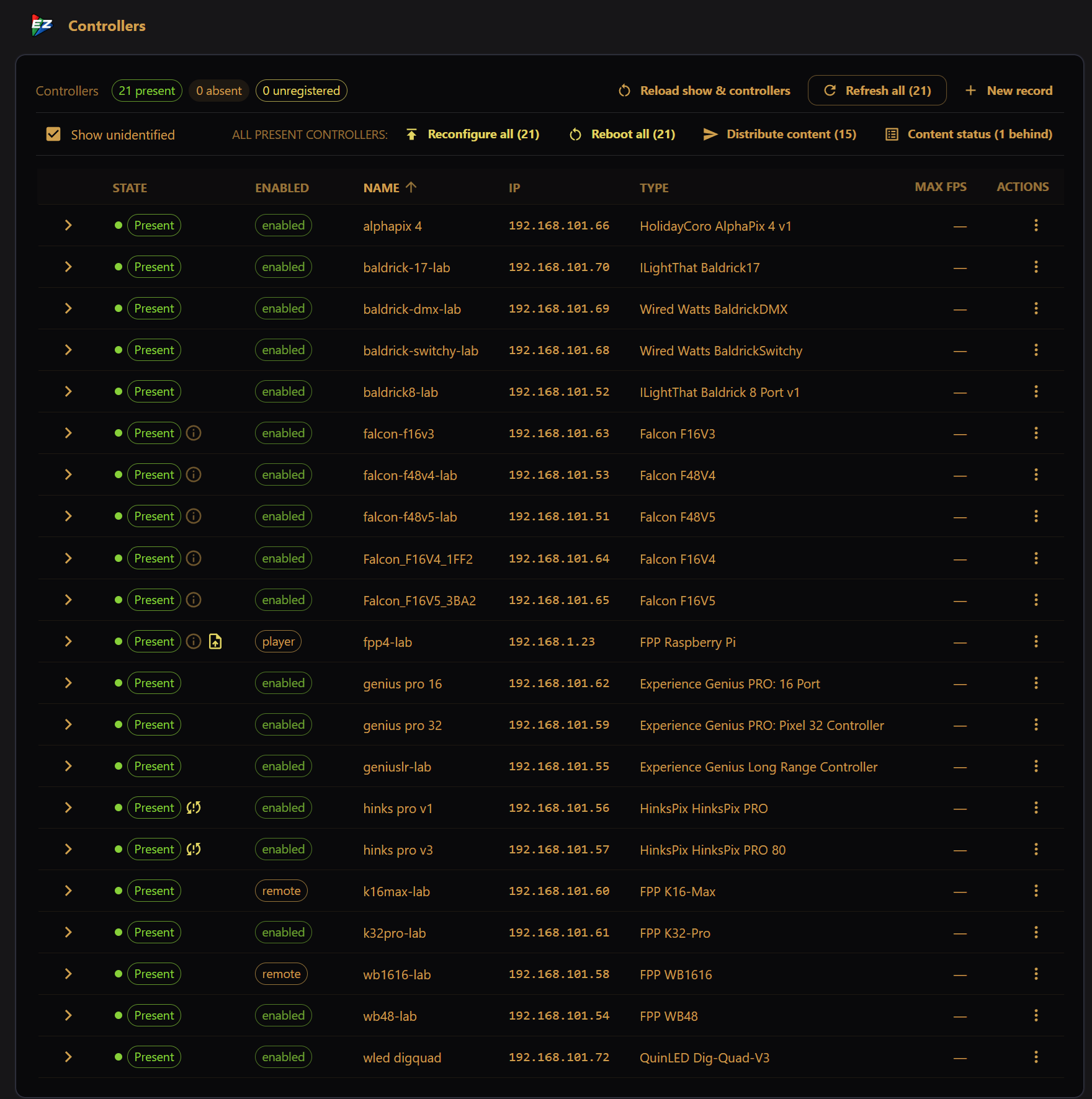
The Controller List on the Controllers screen shows a combination of all configured and detected controller devices.
Above the table, the title row shows a summary of controller status next to the following commands:
- Reload show & controllers re-reads the show folder, resets the layout, reopens all controllers, and restarts the show as applicable.
- Refresh all re-reads the details of every Present controller.
- New record creates an EZPlayer controller record by hand.
The toolbar below it holds the view options on the left ("Show unidentified": when checked, network devices that are not known to be controllers are shown in the table) and, on the right, the bulk device actions that apply to all present controllers:
- Reconfigure all sends the configuration to all the show's controllers and players.
- Reboot all reboots all responsive players and controllers.
- Distribute content sends needed content to the show's players and remotes.
- Content status opens the content status dialog.
Below this is a table with records for each network device / controller:
- Clicking the headers allows sorting of the table
- Each row shows the state, enabled state, name, IP, type, and frame-rate cap ("Max FPS") for a network device
- For devices with details, a foldout icon is available on the left end of the row
- For devices that allow actions, a "kebab" menu is available on the right end of the row
Status / Terminology
Enabled / Disabled / Player / Remote / xLights Only
For controllers that receive data from EZPlayer directly during the show:
- Enabled
 means that the controller is configured for sending live data as part of the show
- Disabled
 means that it is not. The controller is usually disabled by marking it as "Inactive" in xLights.
A controller that keeps its own copy of the show is not sent pixel data, so the Enabled column names the part it plays instead of calling it enabled:
- Player
 plays the whole show from its own copy.
- Remote
 plays its own channels from its own copy, and follows another player's sync for timing.
The role is usually detected from the xLights layout, but Edit record can be used as an override.
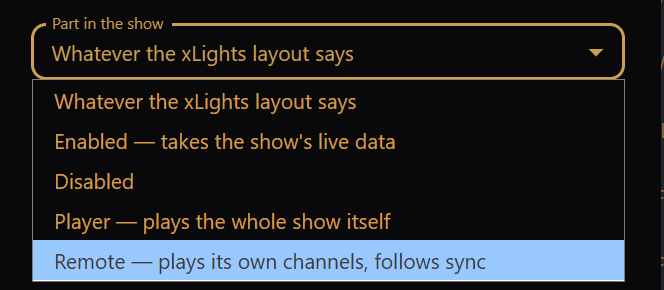
Once the record is changed, the Reconfigure command should be used to inform the controller of its role.
Red / Green / Unlit
Red  / Green
 / Unlit
 status light - Unlit means the controller is disabled. Green indicates that the controller is responding to pings. Red means no ping response.
Present / Absent / Unregistered
A Present  controller is enabled in the controller configuration and is responding to pings. An Absent
 controller is in the configuration but is not responding. An Unregistered
 controller was found during network scan only, and may be responding to pings, but is not in the configuration. An Unknown controller is in the configuration but nothing has looked for it yet: no scan has run and no ping has been tried, which is a weaker statement than Absent.
Details not read
The  mark beside the state means the controller's details (ports, firmware, stats, etc.) have not been read yet. Refresh Details reads them, or the player does on its own when Read controller details automatically allows.
Error Indicator
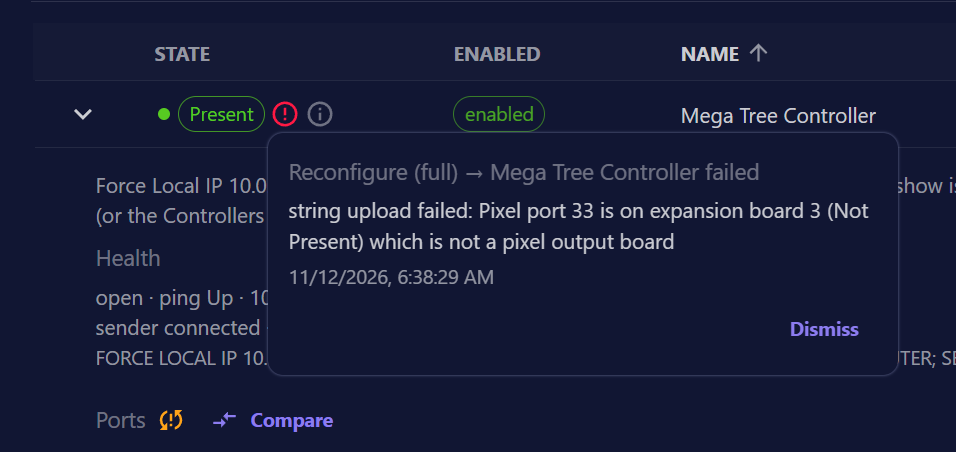
The  indicator appears when the last operation on the controller (a reconfigure, a reboot, a content send) failed. Clicking it shows the message and when it happened; Dismiss clears it.
Warning Alert
A warning  indicator is presented when a controller needs attention. Hovering or expanding the controller details will reveal more about the warning, and clicking it opens a comparison of what EZPlayer expects against what the controller reports.
Several things can require attention:
- Ports or input config differ from expected — Reconfigure the controller.
- The controller is in the wrong mode — it reports itself as a player or a remote while the show wants it to take live data, or the other way round. Also fixed by Reconfigure.
- The player's send list differs from expected — only on an FPP player: a controller is missing from the list, switched off in it, or sent the wrong channels or address. Fixed by Send output universes.
- Content delivery needed
 — the device holds its own copy of the show and that copy is not current; see Content Distribution.
Informational Mark
The  mark indicates there is something that may be worth knowing, but that requires no action. Hovering over the mark gives the details, and clicking opens the comparison.
Max FPS
Some controllers cannot keep up with the show's frame rate. The Max FPS column shows the frame-rate cap in effect for the controller. Use Edit record to set or clear the override; it takes effect the next time the show output is (re)started.
Send-from address
EZPlayer can pin a controller to one of the computer's network interfaces (Force Local IP on the controller, or Global Force Local IP on the Controllers tab). EZPlayer sends from that address and shows it in the controller's details. An address that is not assigned to any network interface on this computer is ignored. Edit record can set a different address for this player; it takes effect the next time the show is reloaded with Reload show and controllers.
Controller Details
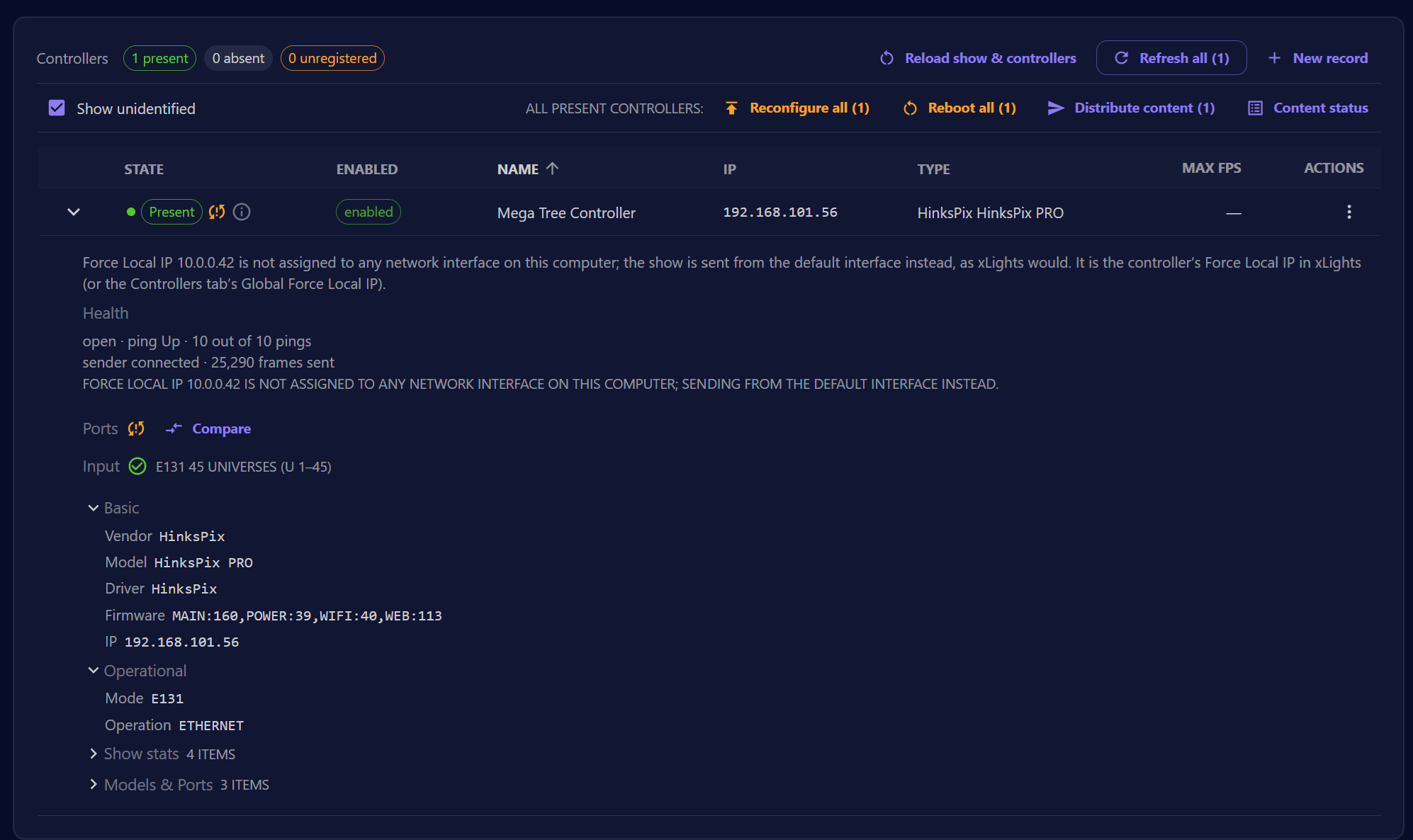
The availability of details varies by controller vendor, model, and installed firmware. See the support matrix for a summary.
Refreshing controller details may be disruptive, so by default it is only done automatically while nothing is playing (see Player settings). Be sure to refresh the controller details for the latest information from your controller.
Health
This section reports high-level health and a description of the controller. It also indicates whether the controller's input and output maps match the player configuration.
Basic
This section provides information about the device type, network address, and installed firmware.
Operational
This section provides modes, uptimes, voltages, temperatures, fan speeds, etc.
Show stats
This section includes network and protocol information for the controller.
Models & Ports
This section details the controller's configured pixel ports and models. Note that this is the controller's information; the Compare option at the top can be used to compare the configuration to that in the port map.